
Publication·
New Nature Communications Paper Explores Brain-Inspired AI for Energy Efficiency
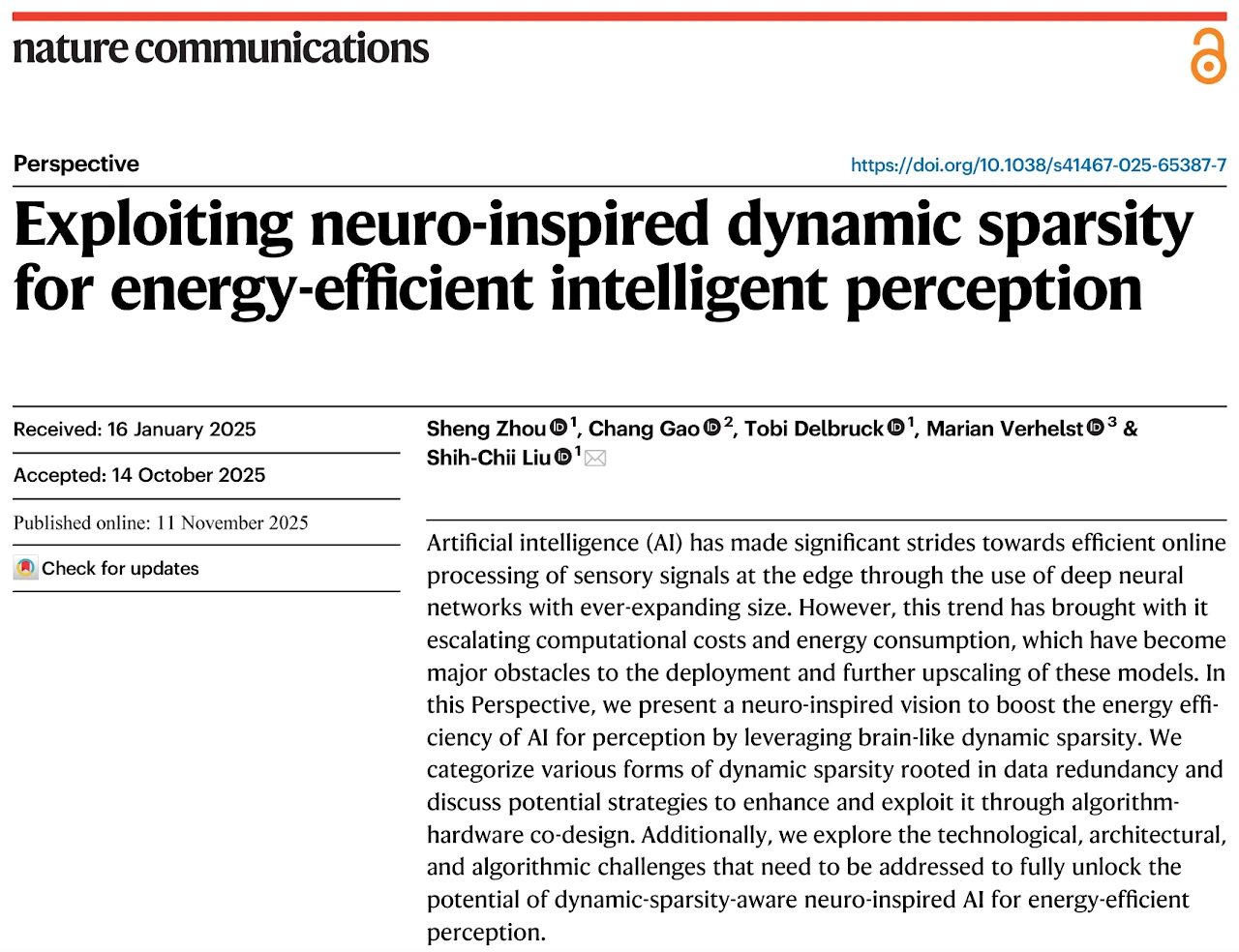
We are thrilled to announce the publication of our new Perspective article, “Exploiting neuro-inspired dynamic sparsity for energy-efficient intelligent perception,” in the latest issue of Nature Communications.
As artificial intelligence models grow, their escalating computational costs and energy consumption have become a major barrier, especially for deployment on edge devices like mobile phones, wearables, and autonomous robots.
In this article, we present a neuro-inspired vision to tackle this challenge. We advocate for leveraging dynamic sparsity, a principle the brain uses to operate with extreme energy efficiency. Instead of processing every piece of information densely, a system using dynamic sparsity selectively activates computations only when and where needed, based on the incoming data.
This Perspective categorizes the different forms of dynamic sparsity and explores algorithm-hardware co-design strategies to fully unlock its potential for the next wave of energy-efficient AI.
This work is a proud collaboration between:
- Sheng Zhou (Institute of Neuroinformatics, University of Zurich and ETH Zurich)
- Dr. Chang Gao (Delft University of Technology)
- Prof. Tobi Delbruck (Institute of Neuroinformatics, University of Zurich and ETH Zurich)
- Prof. Marian Verhelst (KU Leuven & imec)
- Prof. Shih-Chii Liu (Institute of Neuroinformatics, University of Zurich and ETH Zurich)
The article is Open Access and can be read in full at the journal website.
[Link to the full paper:https://doi.org/10.1038/s41467-025-65387-7]